Ran Gvili, Iran, and Us
The following are words I recently shared at an event in the community of Meitar, on behalf of captive hostage Ran Gvili:
“Our dear Itzik and Tali, Ran’s parents, you have just returned from a meeting in the United States with President Trump. It wasn’t you who were privileged to meet him; he was privileged and blessed to meet you. Anyone who meets you comes into contact with the right side of history, the side of truth, morality, justice, and Jewish faith.
“I thought of Ran this week as I lit Shabbat candles. The list that once held so many names has grown shorter and shorter. Every other hostage is either home, or has been brought to burial in Israel. Only one name remains from October 7: Ran ben Tali. An entire people, the entire Jewish world, is focused on one son and one mother.
“There is a message here for all of us. Out of so many names, we are now honoring one Jew, and in doing so we are reminded of what we too easily forget, that every single individual is priceless. We were not able to give every hostage the honor they deserved while they were still with us. But now Ran’s story is told again and again, and it deserves to be told: how a police officer ran toward danger on the morning of October 7, even while recovering from surgery, and helped save hundreds before he was killed near Kibbutz Alumim.
“Ran went out to confront absolute evil. And it is the same evil we see today, asserting itself in Iran against its own people, and elsewhere against anyone who stands for freedom and truth. We pray that this too will fall, that another hateful regime, another Jew-hating empire, will be thrown onto history’s scrap heap, just as others before it.
“Last Shabbat we began reading sefer Shemot, the story of a people redeemed from slavery. Our sages teach: ‘In the merit of the righteous women, our ancestors were redeemed from Egypt, and in the merit of righteous women, we will be redeemed again.’ We have seen so many righteous women in this generation. Tali, I didn’t know you personally before all of this, but I have heard you speak around the world with strength, faith, and unity. You shared that you have recently begun lighting Shabbat candles. Millions of women have been praying for Ran as they light their candles, and now you are praying too, together with them.
“May you merit to bring Ran to burial in Israel very soon. And may we all merit redemption, in every sense of the word.”

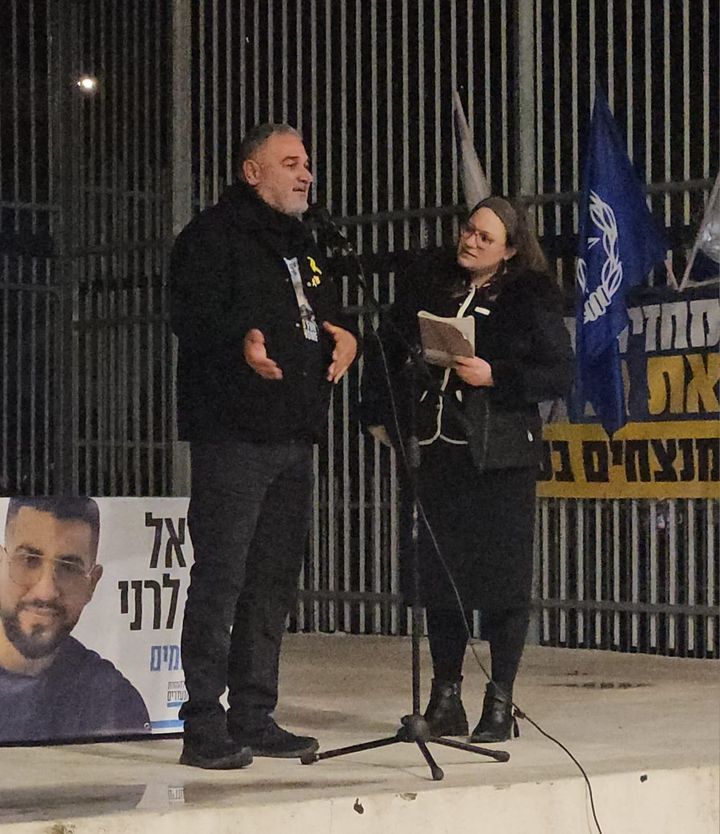
Sivan with Itzik Gvili, father of Ran, z"l
Farewell to Uri Lupolianski, a Man of Kindness and a Constant Smile
When Uri Lupolianski was a young father, he urgently needed medical equipment for his small son. He quickly discovered how complicated, cumbersome, and expensive it was to obtain what his child required. That experience gave birth, in his own home, to Yad Sarah, the monumental, nationwide organization that lends medical equipment to anyone who needs it.
This “empire of kindness” began with a single small vaporizer, loaned to neighbors of the Lupolianski family. Soon, people started bringing walkers, crutches, wheelchairs, and more into the family’s modest apartment. Before long there were additional items, more volunteers, and new branches.
Uri Lupolianski passed away last Wednesday, January 7 at the age of 74. By this time, the organization he founded had received the Israel Prize, helped millions of people, and had become an international model replicated around the world. And he did not lead this vast enterprise with pressure or pride. It was all carried out with his trademark gentle smile. I met him not long ago, and he was exactly as always, in the midst of constant activity, and at the same time, unfailingly gracious.
Last week’s Torah portion says: “Moshe grew up, went out to his brothers, and saw their suffering.” The Torah teaches that a truly great person sees the pain of his brothers. The Exodus begins with Moshe noticing the hardship of his generation and trying to help. That is also how Uri Lupolianski’s public work began: by looking at his brothers and sisters, and seeing what they needed.
Thank you to that young father and for that decision that changed the landscape of chesed in Israel. Even as he was laid to rest, dozens of Yad Sarah branches across the country continued operating, carrying forward his life’s work.

R' Uri Lopiansky, z"l
Parashat Va’Era: Five Points to Ponder
1. This week’s Torah portion includes the first seven of the Ten Plagues of Egypt: blood, frogs, lice, wild beasts, pestilence, boils, and hail. The plagues are not only miracles, but a kind of “educational workshop” as well: ten lessons against idolatry and false gods, and in favor of faith in the Creator and the journey from slavery to freedom.
2. Twice in the parashah, Moshe Rabbeinu describes himself as “arel sefatayim,” a person with impaired speech. And yet God chooses him for leadership (perhaps even precisely because of it?). Clearly, eloquence and charisma are not the main measure of a person.
3. Pharaoh, by contrast, embodies a leadership style that is stubborn and arrogant. Reality speaks to him loudly and repeatedly, but he refuses to listen. With each plague, instead of softening, he hardens, entrenching himself in his arrogance. In every encounter between Pharaoh and Moshe, the contrast is striking.
4. When Moshe comes to the people with the promise of redemption, they do not listen. Why? “They did not listen to Moshe, because of shortness of spirit and hard labor.” It is chilling to think that they were so exhausted and overwhelmed that they could not even hear the news that the bondage was ending. Our commentators explain that we, too, can miss moments of redemption because we are overloaded and stretched too thin.
5. The Shabbat before Rosh Chodesh is called Shabbat Mevarchim, because we bless the new month that will begin in the coming week. This Shabbat, we bless the month of Shevat, which begins on Monday. Shabbat Shalom and Chodesh Tov!