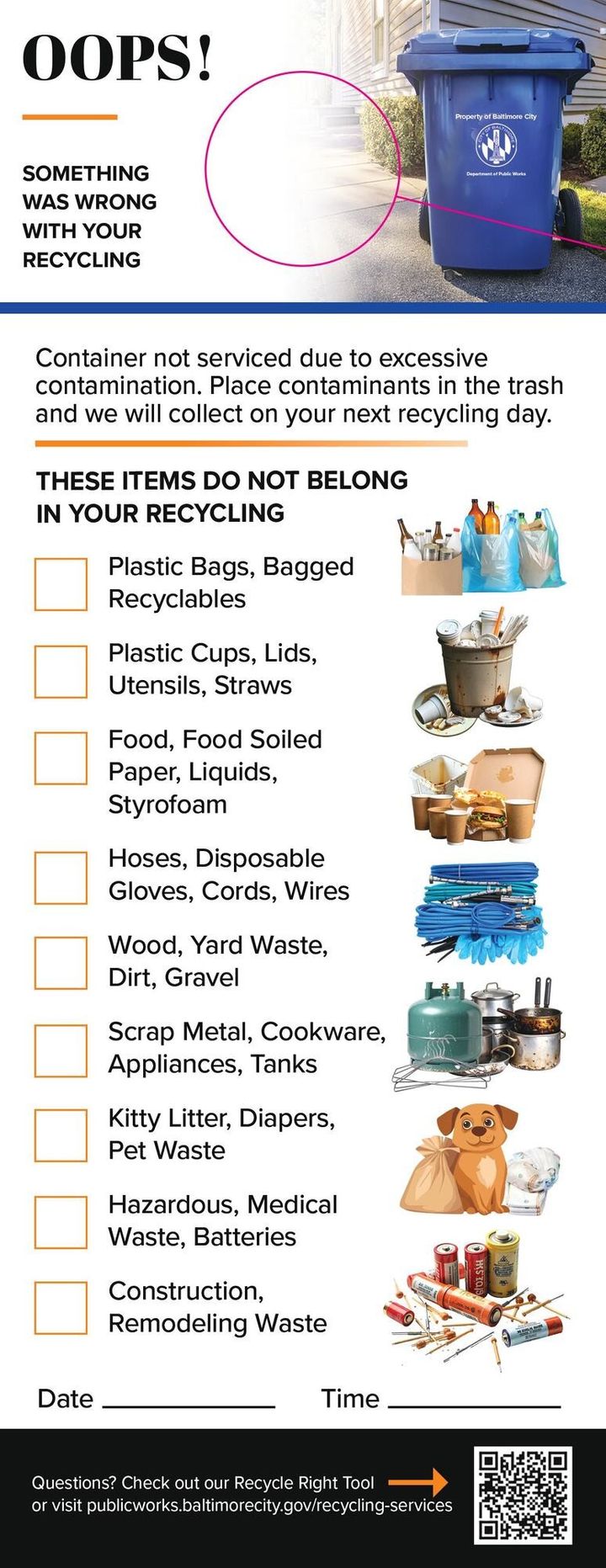
New educational tagging program helps residents recycle correctly and keeps contamination out of the recycling stream
Baltimore, MD - Feb. 24, 2026 - The Baltimore City Department of Public Works (DPW) is launching its new OOPS Tag Recycling Initiative, a citywide program designed to reduce contamination in recycling bins, improve recycling efficiency, and strengthen Baltimore’s environmental sustainability efforts.
Baltimore residents care deeply about their neighborhoods and the environment. However, confusion about what can and cannot be recycled has led to increased contamination in the City’s recycling stream. When non-recyclable items or food residue are placed in recycling bins, entire truckloads of materials may become unusable, increasing processing costs and reducing the effectiveness of Baltimore’s recycling program.
To address this challenge, DPW is placing OOPS Tags on recycling bins found to contain incorrect or non-recyclable items. Each tag clearly identifies the contamination issue and provides guidance on how to properly recycle moving forward. When a bin receives an OOPS Tag, residents will be asked to remove the incorrect items before their recycling is collected on the next scheduled pick-up day.
“Baltimore is committed to leading by example in recycling and environmental sustainability,” said Matthew Garbark, Director of the Baltimore City Department of Public Works. “The OOPS Tag Recycling Initiative strengthens our recycling program, reduces contamination, and helps ensure City resources are used effectively. By working together, residents can make Baltimore a cleaner, more sustainable City for generations to come.”
Why OOPS Tags Are Needed
Recycling contamination occurs when non-recyclable items are placed in recycling bins. Common contaminants in Baltimore include:
- Plastic bags and packaging film
- Batteries
- Tangling items such as hoses and wires
- Textiles and clothing
- Construction and demolition debris
Food residue on containers is also a major source of contamination. When recyclables are not properly cleaned, materials such as paper and cardboard can be ruined and sent to disposal instead of being reused.
What Residents Can Recycle Curbside
DPW reminds residents that acceptable curbside recycling items include:
- Clean paper and cardboard
- Metal cans
- Plastic bottles and containers
- Glass bottles and jars
What Residents Can Expect
DPW residents can expect the following as part of the OOPS Tag Recycling Initiative:
- OOPS Tags will be placed on recycling bins containing incorrect materials
- Tags will identify what was placed incorrectly
- Residents will remove contaminants from the bin
- Recycling will be collected at the next scheduled pickup day
All items should be empty, clean, and dry before being placed in the blue recycling bin.
For materials that are not acceptable at the curb, check out your closest Residential Recycling Center. DPW accepts a variety of materials at the Recycling Centers including mattresses, textiles, electronics, food scraps and more. For more info, visit https://publicworks.baltimorecity.gov/solid-waste/drop-off.
If you are unsure if an item is recyclable, visit DPW’s Recycle Right Tool.